
 Chengdu GreenWater Co.,Ltd
Home
Library
Media
Wastewater Venturi Jet Aeration Design Guide
Wastewater Venturi Jet Aeration Design Guide
Venturi injectors are suitable for projects that require efficient gas-liquid mixing, ozone dosing, pure oxygen aeration, tail gas reuse, or wastewater tank retrofits. They are suitable for various water depths, are convenient to install, can be used for retrofits without shutting down water operation, and can use different gas sources such as air, blower-pressurized air, or pure oxygen according to project needs to adapt to treatment load fluctuations.
The key difference from blower aeration is that a Venturi injector relies on pressurized working fluid to form a high-speed jet and negative-pressure suction, then completes gas-liquid mixing through the diffuser section, pipeline, and secondary nozzle. Compared with traditional blower or mechanical aeration, it offers high oxygen transfer efficiency, lower air supply demand, low energy consumption, simple installation, a small footprint, and low maintenance.
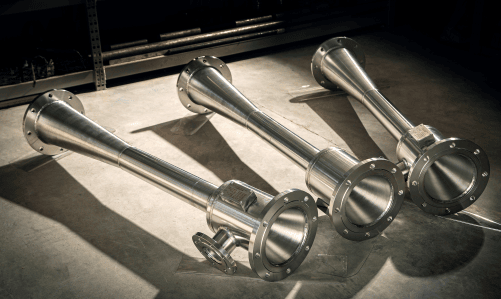
Working Principle
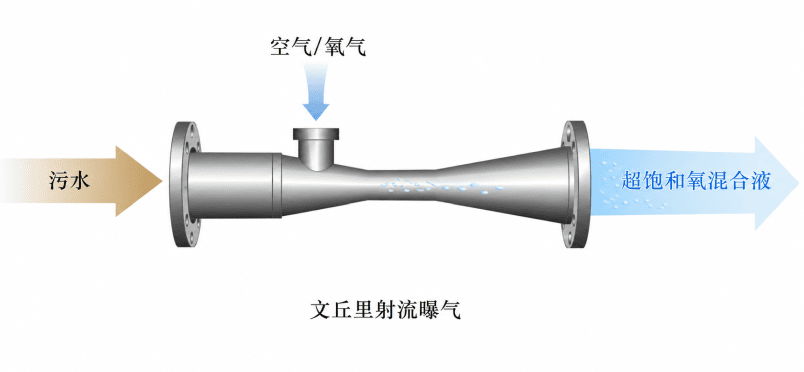
The working process of a Venturi injector can be summarized as pressurized water inlet, high-speed jetting, negative-pressure air suction, and mixed-flow diffusion.
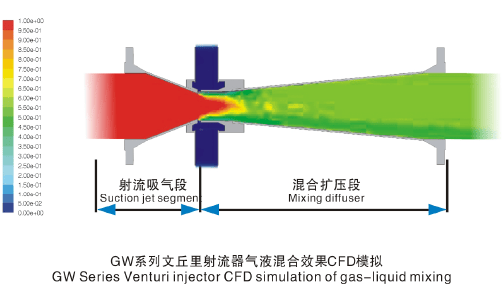
The pressurized working fluid enters the injection chamber from the injector inlet and forms a high-speed jet. After the high-speed fluid creates a pressure drop, it draws in air, pure oxygen, ozone, or liquid chemicals from the suction port and carries them into the working fluid for mixing. When the mixed liquid passes through the diffuser section and reaches the outlet, the flow velocity decreases and the pressure recovers, but the outlet pressure remains lower than the inlet pressure.
In wastewater aeration applications, gas-liquid mixing begins inside the Venturi injector. After gas is drawn in, it rapidly mixes with water. After entering the diffuser section, pressure recovers, and the water-gas mixture continues mass transfer in the conveying pipeline, creating conditions for subsequent secondary jetting and in-tank mixing.
Reasons for Efficient Mass Transfer
Aeration efficiency depends not only on air supply, but also on bubble size, gas-liquid contact time, and mixing intensity. The smaller the bubbles, the larger the gas-liquid contact surface area; the longer the contact time, the easier it is for oxygen to transfer into water; the stronger the mixing and turbulence, the higher the gas transfer rate.
Venturi jet aeration cuts air into microbubbles through two jetting stages and allows the gas-liquid mixture to pass through suction mixing, diffuser mixing, balanced mixing inside the pipeline, and secondary jet mixing inside the tank. This process extends gas-liquid contact time and improves mixing intensity, thereby increasing oxygen utilization and mass transfer efficiency.
The secondary mixing nozzle can also inject the mixed liquid from the injector outlet into a tank, vessel, or pipeline, drawing in several times the surrounding flow to participate in mixing. This further mixes the supersaturated oxygen solution with the tank water while strengthening the in-tank mixing effect.
Key Indicators
SOTR is the oxygen transfer rate under standard conditions and is usually used to evaluate the oxygen supply capacity of aeration equipment under standard water temperature, atmospheric pressure, and deoxygenated clean water conditions. AOTR is the oxygen transfer rate under actual operating conditions and is closer to real project-site performance.
OTE is oxygen transfer efficiency and reflects how much oxygen entering the aeration system is actually transferred into the water. SAE, or power efficiency, is used to measure how much oxygen can be supplied per unit of energy consumption. For wastewater treatment projects, evaluation should not look only at equipment power or only at air supply; actual oxygen transfer rate, oxygen utilization, and unit oxygen supply energy consumption should be compared together.
The mass transfer efficiency and power consumption of Venturi jet aeration are related to multiple parameters, including water depth, gas-water ratio, hydraulic retention time, inlet working pressure, outlet working pressure, water temperature, salinity, and water quality. The design goal should be to meet oxygen demand while maintaining higher oxygen transfer efficiency and lower power consumption.
Selection Parameters
Venturi injector selection should not begin by asking “which model to choose,” but by first clarifying project operating conditions. Usually, the following information is required:
1. Actual oxygen demand or ozone dosing amount
2. Tank dimensions and effective water depth
3. Water temperature, salinity, water quality, and MLSS
4. Target DO or process-controlled DO
5. Gas source type: air, blower-pressurized
air, pure oxygen, or ozone
6. Gas-water ratio or planned air supply
7. Circulating water flow
8. Inlet working pressure and outlet back pressure
9. Hydraulic retention time
10. Whether it is a new project or a retrofit
project without shutdown
When project conditions are close to the conditions given in the standard selection table, the model can be selected directly according to the actual oxygen demand and aeration tank water depth. If site temperature, salinity, dissolved oxygen control value, or other correction factors change, the actual oxygen demand must first be corrected to the corresponding conditions before selecting the model.
Models and Pressure
The Venturi injector model is closely related to water depth, oxygen demand, circulating water flow, and gas supply method. Self-suction usually does not require a blower, making the system simpler. Blower-pressurized operation requires matching both blower air volume and air pressure, and is suitable for conditions requiring higher air supply or stronger control.
For example, under conditions of 4 m water depth and an actual oxygen demand of about 32 kg(O₂)/h, a self-suction or blower-pressurized injector unit that meets the oxygen transfer requirement can be selected. The self-suction solution has simpler equipment, while the blower-pressurized solution requires further blower selection.
For ozone dosing projects, selection must also consider ozone dosage, gas-liquid ratio, motive water flow, number of injectors, and pump head. For example, under conditions of 8.5 m water depth, 40% gas-liquid ratio, and 500 m³/h motive water flow per set, GW3600 can be selected and matched with a pump head of about 12 m.
Pressure design requires special attention: the injector itself does not independently generate a pressure difference. It relies on the power source, injector, and pipeline pressure loss to form the working pressure difference. If the pressure difference is insufficient, air suction will decrease or the system may fail to work normally. Therefore, inlet pressure, outlet back pressure, and pipeline losses should be calculated in system design, and pressure gauges are recommended at the inlet and outlet.
Performance Tables
Performance tables usually provide oxygen transfer rate, water power, air volume, or air pressure for different models at different water depths. When reading a performance table, first confirm the corresponding test conditions, such as water temperature, dissolved oxygen, salinity, and correction coefficients. Only when project conditions match the table conditions, or have been corrected, are the table data suitable for direct selection.
For the self-suction series, focus on model, water depth, oxygen transfer rate, and water power. For the blower-pressurized series, in addition to oxygen transfer rate and water power, pay attention to the air volume and air pressure at the corresponding water depth. As water depth increases, required air pressure usually also increases, so the blower and piping must be checked together.
A performance table is not simply used to choose a “one size larger” device. It is used to compare energy consumption, quantity, layout, and maintenance convenience among different models while meeting oxygen demand.
Aeration Comparison
The advantages of blower fine-bubble aeration are mature technology, wide application, and relatively high initial efficiency. However, in high-salinity, high-hardness, high-MLSS, scaling-prone, oily, or surfactant-containing wastewater, fine-bubble aeration heads may face clogging, aging, and rising maintenance costs.
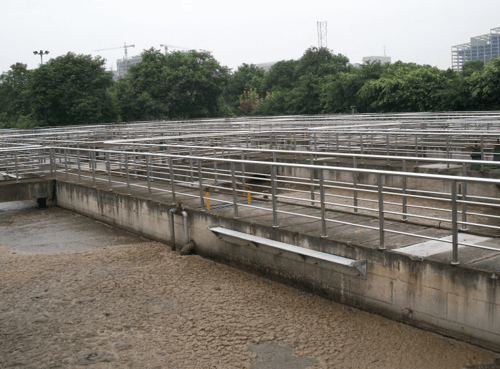
Venturi jet aeration features strong jet mixing, long gas-liquid contact time, low clogging risk, and low maintenance. It can also use self-suction air, blower-pressurized air, pure oxygen, or ozone according to operating conditions. For retrofit projects, especially where shutdown is not possible or the bottom aeration system cannot be replaced on a large scale, Venturi injectors more easily provide practical engineering advantages.
However, Venturi jet aeration is not the default answer for every project. If a project already has a stable blower fine-bubble system, mild water quality, good tank conditions, convenient maintenance, and strong energy performance, the decision should be made after comparing actual oxygen demand, operating electricity consumption, and life-cycle cost.
High-Strength Wastewater
High-strength wastewater changes oxygen transfer conditions. MLSS, salinity, temperature, surfactants, defoamers, and water composition all affect oxygen transfer efficiency. Design should not directly apply clean-water data; standard-condition oxygen transfer capacity should be converted into oxygen transfer capacity under actual operating conditions.
Salinity and corrosive media also affect material selection. For ordinary conditions, brass, stainless steel, high-quality carbon steel, and other materials can be selected according to the application. In ozone or highly corrosive environments, 304 stainless steel may be considered for low-concentration ozone, 316L stainless steel for high-concentration ozone, and more advanced materials such as Hastelloy or titanium alloy for high-concentration chloride ion corrosion.
For ozone, high-salinity, or high-chloride wastewater, selection should evaluate mass transfer efficiency, corrosion resistance, and long-term operating stability at the same time.
Troubleshooting and Maintenance
Common Venturi injector problems include DO decline, reduced air suction, insufficient pressure difference, pipeline blockage, suction pipe blockage, nozzle wear, or internal fouling buildup.
During troubleshooting, first check whether motive water flow and pressure meet the injector operating range, then check inlet and outlet pressure, pipeline resistance, and suction pipe condition. If inlet pressure is low or pressure difference is insufficient, increase the pump head or add a booster pump. If inlet and outlet connecting pipes are too small, use pipes matching the injector inlet and outlet. If the connecting pipeline or suction pipe is blocked, remove the blockage and blow it clean.
After long-term operation, if internal fouling causes dimensional changes, it can be cleaned by soaking in 30% hydrochloric acid for about 30 minutes, then rinsing with clean water. For oxygen systems, related equipment and pipelines should also be cleaned and degreased according to oxygen service requirements and comply with oxygen pipeline installation standards.
Case 1: Ozone Dosing
A municipal wastewater treatment plant with a treatment capacity of 600,000 tons/day adopted ozone dosing for decolorization because the effluent chromaticity was high. The ozone dosing tank measured 45 m × 40 m × 9.5 m, with an effective water depth of 8.5 m. Before ozone dosing, chromaticity was 60, and the requirement was to reduce it to below 15 after dosing. The ozone dosage was 30 mg/L, ozone was produced from pure oxygen, and the total dosing gas volume was 4800 Nm³/h.
The project design gas-liquid ratio was 40%, the design motive water flow was 12000 m³/h, the injector model was GW3600, and the quantity was 24 units. Each injector set had a motive water flow of 500 m³/h, and the pump head was 12 m. After project operation, the injectors worked normally and achieved the designed dosing effect.
Case 2: Tail Gas Reuse
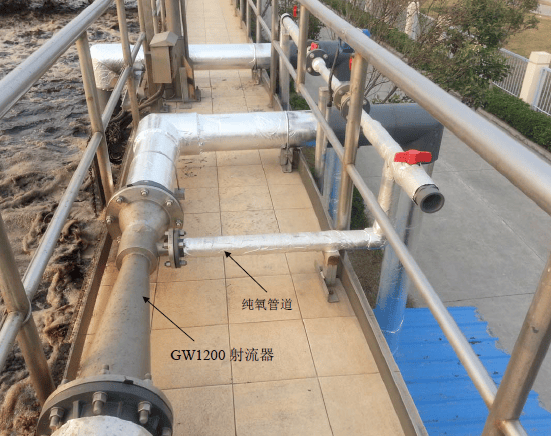
A wastewater treatment project in a chemical industrial park used an ozone advanced oxidation process and consumed 6000 kg of pure oxygen per day. After ozone reaction, the tail gas still contained about 90% pure oxygen. Direct discharge would cause significant waste. Therefore, the project reused ozone tail gas in the aerobic biochemical tank as an aeration oxygen source to reduce the energy consumption of the aerobic biochemical tank.
The project used six GW1200 injectors and twelve sets of secondary jet enhancement devices. Through the negative pressure formed by the injectors, the system drew 5400 kg/d of pure oxygen from the ozone tank 380 m away back to the front-end aerobic tank. The project oxygen utilization rate reached 90%, supplying 4860 kg/d of oxygen to the aerobic tank. After operation, the runtime of the original surface aerators was reduced, lowering power usage by 25% under the current treatment load. The system passed acceptance and met the design requirements.
Design Conclusion
The key to wastewater Venturi jet aeration design is not simply selecting one injector model, but matching oxygen demand, water depth, gas-water ratio, circulation flow, inlet and outlet pressure, temperature, salinity, water quality, and installation method as an integrated whole.
Its engineering value lies in using high-speed jetting to form negative-pressure suction for air, pure oxygen, ozone, or liquid chemicals, and completing continuous mixing through the injector, diffuser section, pipeline, and secondary nozzle. For municipal wastewater, industrial wastewater, ozone dosing, pure oxygen aeration, tail gas reuse, and retrofit projects without shutdown, Venturi injectors are especially suitable where mass transfer efficiency, operating energy consumption, maintenance workload, and retrofit convenience must all be considered.
