
 Chengdu GreenWater Co.,Ltd
Home
Library
Technical Literature
Start and Stop of the GW Jet Aerator
Start and Stop of the GW Jet Aerator
1 Self-Aspirating Jet Aeration for Oxygen Transfer
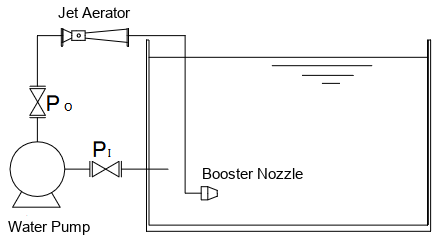
When the self-aspirating jet aerator is installed outside the tank, the air suction port of the ejector should be higher than the water level. If the ejector is installed inside the tank, or installed outside the tank but with the suction port below the water level, the suction pipe must be extended above the water surface.
The process flow of self-aspirating jet aeration is shown in Figure 1.
1.1 Starting the self-aspirating aeration mode
Start the pump according to the pump operation manual, and confirm that the pump is operating normally and rotating in the correct direction. This can be judged by measuring the air velocity at the self-aspirating port for a submersible pump arrangement, or by directly observing the motor rotation when the pump is installed outside the tank.
1.2 Stopping the self-aspirating aeration mode
Stop the pump according to the pump operation manual.
2 Blower-Pressurized Jet Aeration for Oxygen Transfer
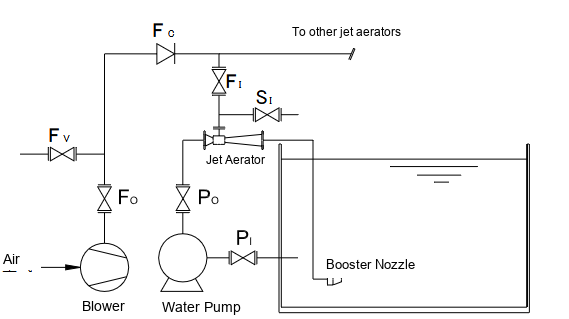
The process flow of blower-pressurized jet aeration is shown in Figure 2. This mode uses both a blower and an ejector. To prevent pump startup problems caused by air entering the pump casing, and to prevent water from entering the blower or air pipeline due to incorrect operation, follow the operating procedure below strictly.
2.1 Status before equipment startup
After installation, the pump and blower are stopped. The blower air inlet valve FI at the ejector suction port is closed. The self-aspiration bypass valve SI, which communicates with ambient air, is fully open. The blower vent valve FV is open.
Operate the pump inlet valve PI and outlet valve PO according to the pump manual. Operate the blower outlet valve FO and vent valve FV according to the blower manual.
2.2 Starting in self-aspirating aeration mode
Start the pump according to the pump operation manual, and confirm normal operation and correct rotation. Measure air velocity at the self-aspirating port for a submersible pump arrangement, or directly observe motor rotation when the pump is installed outside the tank. If suction at the air inlet is obvious, the pump and ejector are operating normally.
2.3 Starting blower-pressurized aeration mode
Important: When starting pumps one by one in blower-pressurized mode, the self-aspiration bypass valve of the ejector connected to any pump that has not yet started must remain open. Do not aerate through the ejector with the blower while the jet pump is not running.
The ejector may be switched to blower-pressurized aeration only after self-aspirating operation has been confirmed as normal.
After confirming that the ejector is operating normally in self-aspirating mode, open the blower air inlet valve FI, start the blower, close the self-aspiration bypass valve SI, and gradually close the blower vent valve FV according to air pressure. After all self-aspiration bypass valves SI have been closed and all blower air inlet valves have been opened, fully close the blower vent valve FV.
2.4 Stopping self-aspirating aeration mode
If the self-aspiration bypass valve SI is higher than the water level, stop the pump directly according to the pump manual. If the self-aspiration bypass valve SI is below the water level, close the bypass valve first, then stop the pump.
2.5 Stopping blower-pressurized aeration mode
For system shutdown, first open the self-aspiration bypass valve SI for venting, then stop the blower, close the blower air inlet valve FI, and then stop the pump. For shutdown of a single unit, close the blower air inlet valve FI, open the self-aspiration bypass valve SI, and then stop the pump.
Do not stop the pump while the blower is running and the blower air inlet valve FI is open. Otherwise, air may flow backward into the pump casing and affect the next startup. If the pump stops due to a fault, close the blower air inlet valve FI and the pump inlet and outlet valves PI/PO. If a self-aspiration bypass valve SI is provided, it may also be opened for venting.
When the blower is stopped, whether due to fault or system shutdown, both pumps that are not stopped and pumps that have not yet started should have the blower air inlet valve FI of the corresponding ejector closed and the self-aspiration bypass valve SI opened. This prevents operating ejectors from creating a siphon effect at that point and drawing tank water into the blower pipeline.
2.6 Mixed operation of self-aspirating and blower-pressurized aeration
When all ejectors are in operating condition, the system can switch between self-aspirating jet aeration and blower-pressurized jet aeration, or operate with both modes combined, according to wastewater flow and water quality. This can help achieve better energy-saving performance.
Main operating modes include: (1) all units in self-aspirating jet aeration mode with the blower off; (2) some units in self-aspirating mode and some in blower-pressurized mode, with the blower running and air volume reduced by variable-frequency control to save energy; (3) all units in blower-pressurized jet aeration mode with the blower running.
2.7 Valve positions under blower-pressurized aeration conditions
| Condition | Blower outlet valve FO | Blower vent valve FV | Blower air inlet valve FI | Self-aspiration bypass valve SI | Pump inlet valve PI | Pump outlet valve PO |
|---|---|---|---|---|---|---|
| Pump off / Blower off | Closed | Open | Closed | Open | Closed | Closed |
| Pump on / Blower off | Closed | Open | Closed | Open | Open | Open |
| Pump on / Blower on | Open | Closed | Open | Closed | Open | Open |
| Pump off / Blower on | Open | Closed | Closed | Open | Closed | Closed |
Note: Pump off / blower on refers to the condition in which the pump fails suddenly while both pump and blower are running. In this condition, close the blower air inlet valve FI of the ejector connected to that pump as soon as possible, open the self-aspiration bypass valve SI, close the pump inlet valve PI and pump outlet valve PO, and restore the system to the pump on / blower on condition after the pump has been repaired.
3 Ozone Dosing by Jet Ejector
After installation, the pump is stopped and the ozone inlet valve at the ejector suction port is closed.
Startup: Start the pump according to the pump operation manual, and confirm normal operation and correct rotation. Measure air velocity at the self-aspirating port for a submersible pump arrangement, or directly observe motor rotation when the pump is installed outside the tank. If suction at the air inlet is obvious, the pump and ejector are operating normally. After the pump operates normally, close the ejector self-aspirating air valve and open the ozone inlet valve.
Shutdown: Close the ozone inlet valve first, then shut down the pump and valves according to the pump operation manual.
