
 Chengdu GreenWater Co.,Ltd
Home
Library
Media
Jet Mixer (Hydraulic Mixing Nozzle)
Jet Mixer
Components, Working Principle, Advantages, Models, and Applications
A jet mixer is a hydraulic mixing device powered by pressurized liquid. It creates a high-velocity jet that moves the surrounding tank liquid and forms a circulation pattern without a submerged motor or mechanical drive.
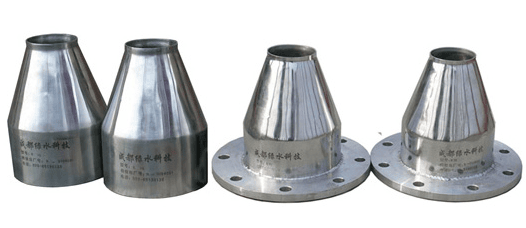
Jet mixers are suitable for wastewater treatment, jet aeration, ozone contact, chemical-liquid mixing, and tanks where solids may settle.
Main Components
- Inlet connection: Usually a flange that connects the nozzle to the circulation pipe and receives pressurized liquid.
- Converging section: Reduces the flow area and converts liquid pressure into velocity.
- Discharge opening: Forms the high-velocity jet. Its size and direction affect jet distance and circulation coverage.
- Nozzle body: Maintains the internal flow path and supports pipeline pressure. Stainless steel or corrosion-resistant materials may be used.
Working Principle
- A circulation pump supplies pressurized liquid to the nozzle.
- The liquid accelerates through the converging passage and forms a high-velocity jet.
- The jet entrains liquid around the nozzle, causing more liquid to move.
- Momentum transfer creates a large circulation pattern and produces uniform mixing in the tank.
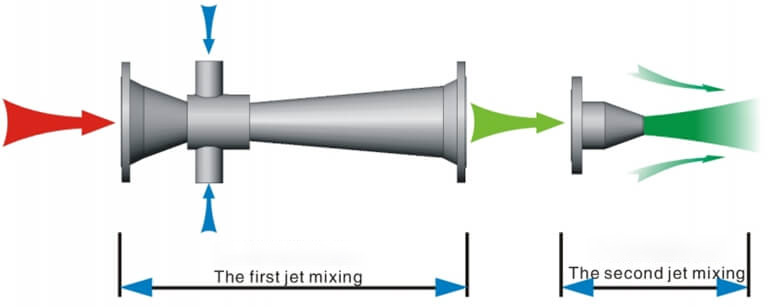
Operating note: According to the current product information, the jet can move approximately three to five times its own flow rate in surrounding liquid. When installed after a Venturi injector, it can also improve secondary gas-liquid mass transfer.
Key Advantages
- No moving mechanical parts: Simple construction and stable operation.
- Low maintenance: No complex transmission mechanism and limited routine maintenance.
- Large mixing coverage: The jet moves surrounding liquid and creates a wide circulation area.
- Flexible arrangement: Quantity, location, and direction can be adjusted for different tanks and water depths.
- Improved mass transfer: When combined with a Venturi injector, it improves the distribution of air, oxygen, or ozone.
- Suitable for difficult conditions: Available for corrosive liquids, deep tanks, and locations where mechanical equipment is difficult to maintain.
Model Specifications
| Model | Inlet | Operating Flow (m³/h) | Service Width (m) | Service Length (m) |
|---|---|---|---|---|
| N20 | DN50 | 4.7-12.6 | ≤1.5 | 3-7 |
| N30 | DN80 | 10.7-28.3 | ≤2.0 | 3-7 |
| N40 | DN100 | 19.0-50.2 | ≤2.5 | 3-7 |
| N50 | DN100 | 29.7-78.5 | ≤2.5 | 3-7 |
| N60 | DN150 | 42.7-113.1 | ≤3.0 | 3-7 |
| N70 | DN150 | 58-154 | ≤3.5 | 3-7 |
Selection note: Tank dimensions, liquid depth, pump pressure, pipeline loss, liquid properties, nozzle quantity, and installation direction must also be considered.
Applications
- Wastewater treatment: Mixing in equalization, reaction, and biological treatment tanks.
- Jet aeration: Works with a Venturi injector to improve oxygen supply and tank circulation.
- Ozone contact: Provides hydraulic mixing and secondary mass transfer in ozone contact tanks.
- Chemical processing: Mixing liquids or liquid-solid mixtures in reactors and storage tanks.
- Settling prevention: Keeps suspended solids moving and reduces local deposits.
- System retrofits: Improves weak circulation, uneven mixing, and local dead zones in existing systems.
Conclusion
A jet mixer uses a high-velocity liquid jet to entrain surrounding liquid and create broad circulation without submerged moving machinery. It is flexible to install, requires little maintenance, and can improve gas-liquid mass transfer when used with a Venturi injector.
