
 Chengdu GreenWater Co.,Ltd
Home
Library
Technical Literature
Application of jet aeration in bleaching and dyeing production wastewater treatment projects
Application of jet aeration in bleaching and dyeing production wastewater treatment projects
Xintianlong Group Bleaching and Dyeing Factory · Chengdu Green Water Technology Co., Ltd.
1. Project Overview
The bleaching and dyeing wastewater generated during the production process of the Xintianlong Group Bleaching and Dyeing Factory (hereinafter referred to as the customer) is treated by a biochemical system. However, the microporous aerator used in the original system has been blocked, cracked, aged, etc., resulting in uneven aeration and reduced processing capacity. Replacing the original aeration equipment requires shutting down and draining water, and the cost of equipment replacement is high. The customer hopes to replace his original aeration equipment with a more efficient jet aerator that does not require maintenance, does not require shutting down and draining water during installation, and is more efficient. In order to clearly compare the efficiency of the original microporous aeration equipment and the jet aeration equipment, the customer changed the inefficient anaerobic tank in the original process to an aeration tank (using jet aeration), and ran it in parallel with the original contact oxidation tank using microporous aeration. The modified flow chart is as follows:
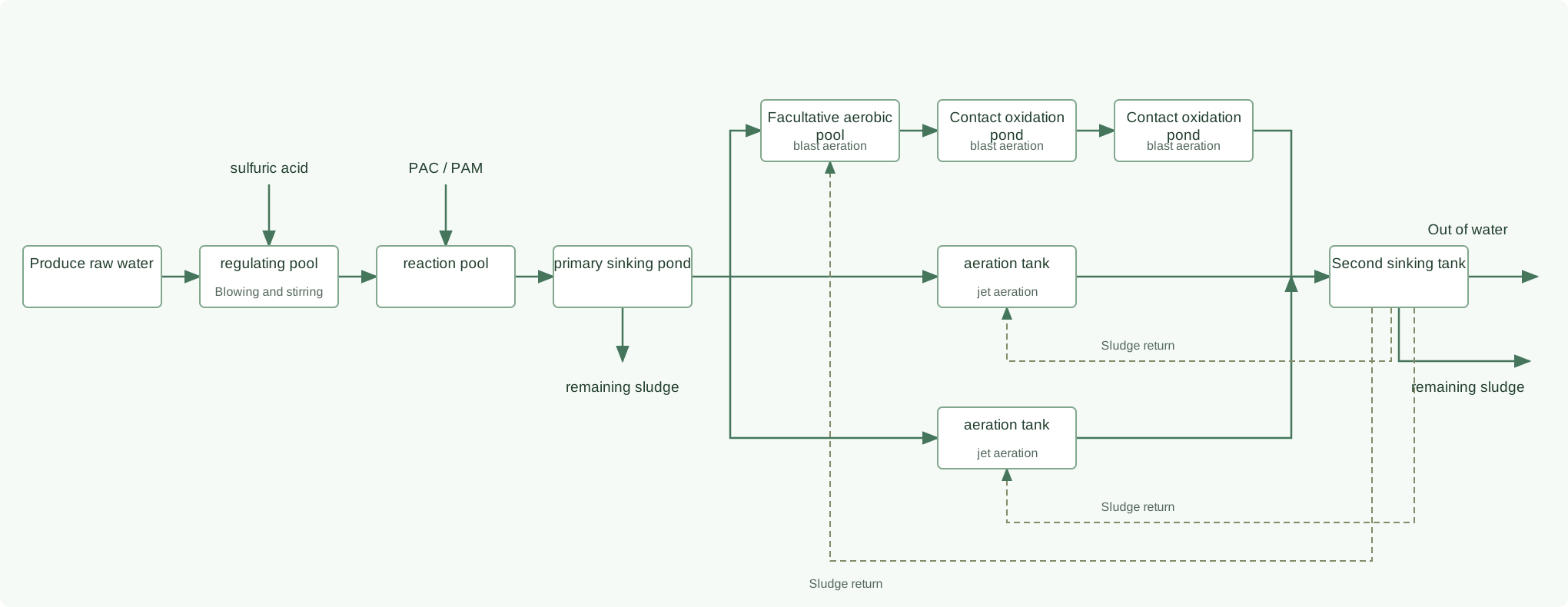
After passing through the regulating tank, reaction tank and primary sedimentation tank, the raw production water enters the original facultative oxygen tank, the two-stage contact oxidation tank branch, and the two jet aeration tank branches respectively, and then enters the secondary sedimentation tank and discharges water. Sulfuric acid is added to the regulating tank and stirred by blast, and PAC and PAM are added to the reaction tank; the system is equipped with sludge return and residual sludge discharge.
2. Implementation status
The anaerobic tank in the original system was transformed into two aeration tanks, and the wastewater was treated in parallel with the contact oxidation tank. A jet aeration system was used for each of the two transformed tanks for aeration. Because the customer originally had a blower, in order to improve the flexibility of the entire water treatment system and reduce energy consumption, we designed the aeration system as a jet aeration system that can operate both by blowing and pressurizing and by self-priming.
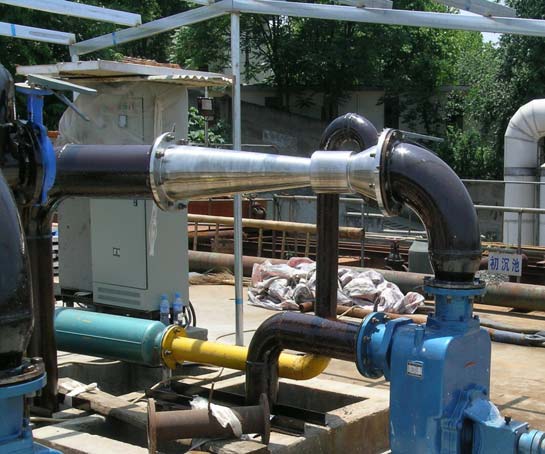
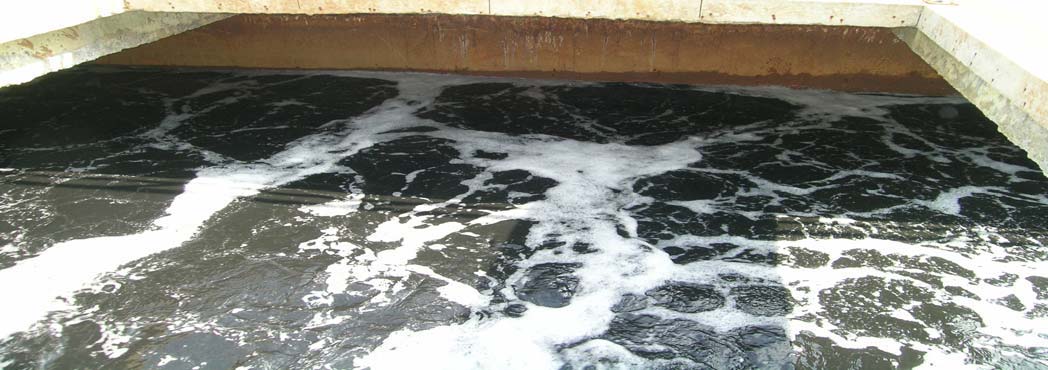
3. Comparison of installed energy consumption and nameplate unit degradation energy consumption
When the water quality and volume are the same, the installed power of the jet aeration system is much lower than that of the original blast aeration system, and the operating cost is reduced. The comparison results are shown in Table 1.
| project | Original blast aeration system | jet aeration system: self-priming mode | jet aeration system: blast pressure mode |
|---|---|---|---|
| Treatment water volume (m³/h) | 15 | 15 | 20 |
| Installed power (kW) | 30 | 15 | 22.5 |
| Nameplate unit degradation energy consumption (kWh/kgCOD) | 1.13 | 0.46 | 0.43 |
4. Actual operation processing effect
In the design, we took into account the changes in the quality and quantity of the customer's production wastewater and the need to expand production and designed two operating modes: blowing, pressurization and self-priming. When the water volume is 15 m³/h and the effluent COD is required to be 1000 mg/L, the self-priming mode is used to operate; when the water volume is 20 m³/h and the effluent COD is required to be 500 mg/L, the blast and pressurized mode is used to operate. The treatment effects are shown in Table 2.
| category | Technical Agreement Requirements | Actual operating value: Jet self-priming | Actual operating value: blast pressure |
|---|---|---|---|
| Single set of water treatment volume (m³/h) | 15 | 15 | 20 |
| COD inlet water quality (mg/L) | 3000 | 3135 | 3135 |
| COD effluent quality (mg/L) | 1000 | 972 | 500 |
| COD removal rate (%) | 66.7% | 69.0% | 84.1% |
| Actual operating power consumption per unit of degraded COD (kWh/kgCOD) | 0.33 | 0.26 | 0.16 |
| Oxygen utilization rate (%) | 30% | 35% | 30% |
| Actual power efficiency (kg(O₂)/kWh) | 1.31 | 1.54 | 1.73 |
| Nameplate power efficiency (kg(O₂)/kWh) | 0.86 | 0.87 | 1.11 |
5. Actual operation conditions show that the use of jet aeration has the following advantages:
- The oxygen utilization rate is high, the self-priming oxygen supply reaches an oxygen utilization rate of 35%, and the effluent water quality meets the design requirements.
- Compared with micropore aeration, jet aeration has greatly reduced noise and energy consumption. The actual energy consumption per 1 kg of COD degraded is only 0.26 kWh.
- jets and booster nozzles require no maintenance.
- Easy maintenance, the water pump is installed outside the pool, only the water pump needs to be maintained, and there is no need to stop and drain the water during maintenance.
- Compared with micropore aerators, jet aerator avoids clogging, aging and uneven aeration of the aeration head.
