
 Chengdu GreenWater Co.,Ltd
Home
Library
Media
Jet Aerators in Wastewater Treatment: Working Principles and Application Cases
Jet Aerators in Wastewater Treatment: Working Principles and Application Cases
Jet Aerators use liquid as the working medium and use the Venturi principle to generate negative pressure when the liquid is sprayed at high speed, so that the mixed liquid (sewage + sludge) sucked by the water pump is jet-mixed with air/oxygen in the ejector to form a supersaturated oxygen mixed liquid, achieving aeration and oxygenation, and efficient mass transfer.
The selection of Jet Aerators includes three parts: jet unit selection (the jet unit is composed of a water pump and a jet), efficiency nozzle selection, and fan selection (a fan is not required for self-priming jet aeration, but is required for forced jet aeration).

Jet Aerators are mainly used for biological aeration and oxygenation in rivers, urban domestic sewage and industrial wastewater treatment; they can also be used in chemical industry, chemical fiber, medicine, food, grease, printing and dyeing, light industry, metallurgy, tanning, environmental protection and other industries.
It is suitable for new projects, as well as renovation projects that do not stop water supply or release water.
Jet Aerators can use different gas sources (air, fans, pure oxygen) to meet fluctuations in processing load.
The ejector and booster nozzle require no maintenance for long-term operation.
How jet aeration works
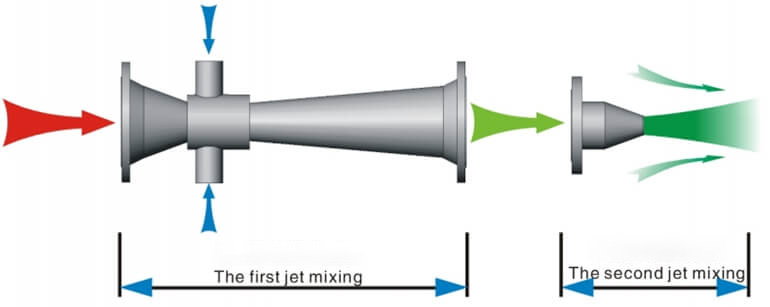
First jet: Inhale gas and mix:
The pressurized working (power) fluid enters the injection chamber from the inlet of the jet to form a high-speed jet fluid. The high-speed fluid generates a pressure drop, causing the material to be added (liquid/gas) to be sucked in from the suction port and enter the working fluid. The resulting mixed liquid reaches the ejector outlet through the diffusion section, and the flow rate slows down and the pressure rises (but is lower than the inlet pressure). The venturi ejector has high mixing efficiency and a wide working pressure range. As long as there is a small pressure difference between the inlet and outlet, a negative pressure can be formed to suck in liquid or gas.
Second jet: Booster nozzles promote mixing in the pool:
After the working fluid and the sucked medium are mixed and transferred for the first time in the venturi ejector, they are then injected into the pool/container/pipe through the synergistic nozzle, attracting 4-5 times the flow rate of the working fluid for secondary mixing, thereby improving the transfer efficiency of the sucked medium in the main fluid.
Install:
The installation outside the pool is mainly divided into pipeline pump, vertical pump and self-priming pump dry installation according to the water pump. It is suitable for newly built or renovated above-ground aeration tank and underground aeration tank structures. The installation is very fast and convenient, and the pipeline is simple.
Application case 1: Transformation of pharmaceutical wastewater aeration system
This project is a wastewater transformation project of Shangyu Xinhecheng Biochemical Co., Ltd. The aerobic tank of this project is divided into two pools, the south and the north, which operate in parallel, with a water treatment capacity of 1500m3/d, that is, 62.5m3/h. The original bulk flow aeration method was used, but the use time was too long, the efficiency dropped, the operating cost was high, the dissolved oxygen content was insufficient, and the design indicators were not met. Under the premise of non-stop water supply, in order to improve the quality of the effluent and reduce the cost of sewage treatment, the customer decided to use ejector to transform the aerobic north tank.
After the equipment was put into operation, the water quality of the aerobic south tank became better and the water quality of the north tank deteriorated. After analysis, it is not the cause of the injector and design, but the following three issues:
1. Insufficient and uneven air volume distribution
2. Uneven water distribution
3. Water pump cavitation
After solving the above problems, the COD of the aerobic north tank effluent is basically 1200-1300mg/L, and the dissolved oxygen is 3-7mg/L, reaching the designed water quality indicators. The north tank has always maintained a high level of dissolved oxygen, indicating that the aeration system of the north tank still has some spare capacity.
Application case 2: Sequencing batch activated sludge process to treat slaughter wastewater
Based on the calculation of design selection parameters and combined with the performance parameters of the ejector, one set of Jet Aerators was selected for each sludge tank. The specific parameters of a single set of Jet Aerators
are as follows:
1. Injector model and quantity: GW800, 1 piece;
2. Enhanced nozzle model and quantity: N70, 2 pcs;
3. Parameters and quantity of supporting water pumps: flow rate is 160m3/h, lift is 15m, 1 unit.
The quality of the system’s inlet and outlet water actually tested after the equipment was put into operation:
| Parameter | Influent | Effluent |
|---|---|---|
| BOD5 | 700~800 | 32 |
| COD cr | 1800 | 79.2 |
| Ammonia nitrogen | 40 | 8.6 |
| SS | 400~600 | 10 |
| water temperature | 20~50℃ | - |
