
 Chengdu GreenWater Co.,Ltd
Home
Library
Technical Literature
Jet Aerator Printing And Dyeing Wastewater Treatment Case
Jet aerator printing and dyeing wastewater treatment case
In the field of printing and dyeing wastewater treatment, the stability and oxygenation efficiency of the aeration system directly affect the biochemical treatment effect, operating energy consumption and subsequent maintenance costs. For many sewage treatment stations that have been in operation for many years, traditional microporous aeration devices often suffer from problems such as blockage, cracking, and reduced efficiency after long-term use, which in turn affects the compliance of water output and the stable operation of the system. In response to the pain points of this industry, the application of jet aerators in printing and dyeing wastewater treatment renovation projects has demonstrated strong engineering adaptability and practical operation value.
A small and medium-sized printing and dyeing wastewater treatment renovation project implemented by Chengdu GreenWater Co., Ltd. in Changzhou, Jiangsu Province is one of the more representative cases. The original aeration tank of this project used a microporous aeration device. However, as the use time increased, the microporous tubes gradually aged and appeared clogging and cracking, resulting in a decrease in aeration efficiency and difficulty in achieving the design specifications. At the same time, when the original system is overhauling and replacing the microporous aeration device, the water needs to be stopped and drained, and the sludge must be re-cultivated after the overhaul is completed. Not only does it take a long time, but the maintenance cost is high, which puts great pressure on the customer's daily operation and management.
Project diagram
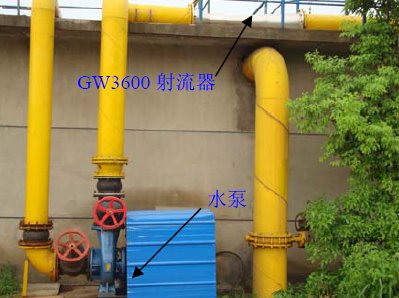
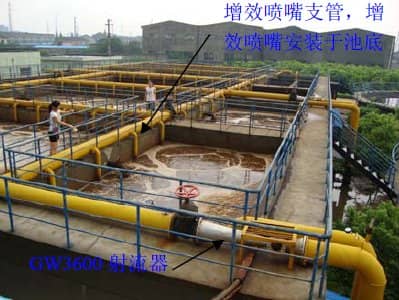
Against this background, the project party chose to use jet aerators to transform the original system. Compared with traditional microporous aeration methods, jet aerators have obvious advantages in installation methods, operation and maintenance, and system adaptation. The system is mainly composed of water pumps, connecting pipes, ejectors and synergistic nozzles. The pipeline layout is relatively simple, and it can realize non-stop and discharge installation, which greatly reduces the impact of the transformation process on the operation of the original sewage treatment system.
From the perspective of process design parameters, the project's designed water treatment volume is 3000m3/d, and the aeration time is 24h. The size of the aeration tank is 40m×19.5m×5.4m, divided into 5 grids, with a super height of 0.6m and an MLVSS of 2500mg/L. The designed inlet water COD is 800~1200mg/L, and the design outlet water requirement is ≤100mg/L. Based on the actual needs of the project and equipment performance parameters, 4 sets of GW3600 jet aerators were finally selected, equipped with 108 N40 efficiency-enhancing nozzles. One set of GW3600 is equipped with a 37kW water pump, with a flow rate of 550m3/h, and a lift of 15m; the other three sets are equipped with a 30kW water pump, with a flow rate of 480m3/h , and a lift of 14m.
This selection method is not standardized, but customized according to the project pool type, water volume, water quality and customer requirements. Because of this, the jet aerator can not only meet the aeration and oxygenation needs, but also take into account the mixing effect in the pool, avoid waste of energy consumption, and achieve an effective match between equipment configuration and treatment goals.
Judging from the actual operating results, after the equipment was put into operation, the water treatment volume of this project remained at 3000m3/d. The measured COD of the incoming water is 800-1000mg/L, and the COD of the effluent is stable at ≤80mg/L, which is better than the original designed effluent index. The total power used by the project is 127kW, the corresponding COD degradation amount is 2.16~2.76t/d, and the unit degradation energy consumption is 1.41~1.1kWh/kgCOD. It can be seen from these operating data that the jet aerator can not only meet the treatment effect requirements in the printing and dyeing wastewater treatment renovation project, but also has good energy consumption control performance.
In addition to treatment effect and energy consumption performance, jet aerators also have obvious advantages in terms of operational stability and maintenance convenience. After the project is put into operation, the mixing and oxygenation in the aeration tank will be more uniform, and there will be no dead zones, which will help maintain the stable operation of the biochemical system. At the same time, the jet aerator has low noise, successfully solving the problem of high noise in the original blast aeration system and improving the on-site operating environment. More importantly, the ejector and water pump are installed outside the pool, so installation and maintenance can be completed without stopping or draining water, significantly reducing the risk of downtime.
From a maintenance perspective, the ejector and booster nozzle themselves require little maintenance, and only require regular maintenance of the water pump. This is in sharp contrast to traditional microporous aeration systems. Once the traditional microporous aerator is clogged or aged, it will not only be complicated to repair, but will also affect the operation of the entire pool. The core components of the jet aerator have low maintenance requirements, small maintenance workload, and the comprehensive maintenance cost of long-term operation is significantly lower. This is especially important for printing and dyeing enterprises, because continuous and stable production usually means that the sewage treatment system must maintain a high online rate and reliability.
From the perspective of industry application, printing and dyeing wastewater has the characteristics of large fluctuations in organic matter concentration, obvious changes in treatment load, and high requirements for aeration and mixing. Simply relying on traditional aeration methods is often prone to problems such as insufficient oxygenation, local dead zones, and difficulty in maintenance after the equipment ages or the working conditions change. The jet aerator can better adapt to the complex working conditions in printing and dyeing wastewater treatment through the synergy of "oxygenation + stirring", and is especially suitable for project scenarios such as upgrading and renovation of old sewage stations, updating aeration systems, and projects that require non-stop production and renovation.
Based on this case, it can be seen that the application value of jet aerator in printing and dyeing wastewater treatment is mainly reflected in the following aspects: first, flexible installation, which can realize non-stop water discharge construction; second, uniform mixing and oxygenation, which helps to reduce the aeration dead zone; third, low noise, which improves the on-site operating environment; fourth, the maintenance workload is small, which significantly reduces the cost of later maintenance; fifth, the water output is stable and can meet the first-level requirements of the national comprehensive sewage discharge standard.
For companies that are upgrading printing and dyeing wastewater treatment, building new sewage station facilities, or planning to replace the original microporous aeration system, jet aerators provide a solution that takes into account treatment effects, maintenance convenience, and comprehensive operating costs. Especially as environmental protection standards continue to improve and companies pay more attention to stable compliance and energy conservation and consumption reduction, choosing aeration equipment suitable for actual working conditions has become one of the key factors for the success or failure of industrial wastewater treatment projects.
If you are paying attention to the application of jet aerators in printing and dyeing wastewater treatment, or want to know more about the aeration transformation plan that is more suitable for your own project, equipment selection and system design based on specific water volume, water quality and tank conditions will be more helpful in improving project operation effects and investment returns.
Company website: https://cd-greenwater.com
Technical contact number: 028-85130135
Customer service contact number: 18515915124
Contact email: jane1984@cd-greenwater.com
Address: No. 191, Section 1, Changcheng Road,
Xihangang, Shuangliu District, Chengdu City
