Chengdu GreenWater Co.,Ltd
Home
Library
Technical Literature
Application of Jet Aerators in Slaughterhouse Wastewater Treatment
Application of Jet Aerators in Slaughterhouse Wastewater Treatment
1. Project Overview
The slaughterhouse processes 300 to 500 pigs per day, with peak throughput of about 1,500 pigs per day. It generates approximately 100 m3/d of slaughterhouse wastewater. Because production is scheduled for half days, with slaughtering concentrated in the afternoon, the wastewater flow is highly uneven and has a large hourly variation coefficient. Peak discharge can reach 30 to 40 m3/h.
2. Wastewater Conditions
1. Wastewater type
Slaughterhouse wastewater.
2. Water quality and flow characteristics
The wastewater mainly comes from pre-slaughter rinsing, cleaning of pork and internal organs after slaughter, and washdown water from pig pens, slaughtering equipment, and the work area. Its main characteristics are large fluctuations in both flow and quality, with slaughtering concentrated from 15:00 to 20:00; high organic loading; and high suspended solids. The wastewater contains substantial amounts of blood, grease, pig hair, meat scraps, internal organ residues, undigested feed, manure, and other pollutants.
3. Jet Aerator Design Parameters
- Design treatment capacity: 100 m3/d.
- Design influent quality and discharge standard are shown below:
| No. | Parameter | Influent | Effluent |
|---|---|---|---|
| 1 | BOD5 | 700 | ≤50 |
| 2 | CODcr | 1200 | ≤120 |
| 3 | Ammonia nitrogen | 50 | ≤10 |
| 4 | SS | 400 | ≤100 |
| 5 | Water temperature | 30°C | - |
- Aerobic treatment process: SBR process.
- Aeration basin size and quantity: the SBR basin is divided into two cells, each measuring 6 × 3 × 4 m (L × W × H).
- SBR operation: the two cells operate with an aeration time of 6 to 8 h, filling time of 0.5 h, settling time of 1 h, and decanting time of 2.5 h. Two operating cycles are completed per day.
4. Jet Aerator Selection
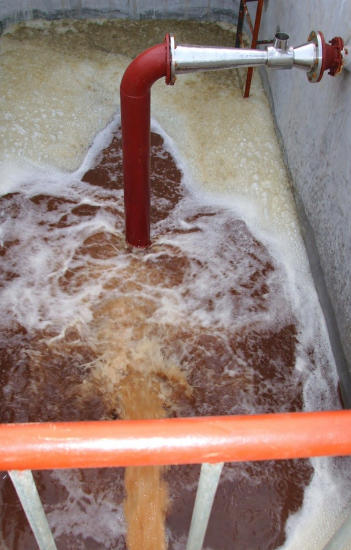
Based on the design parameters and the jet aerator performance data,jet aerator set was selected for each SBR cell. The parameters of each set are as follows:
- Jet aerator model and quantity: GW800, 1 set;
- Efficiency-enhancing nozzle model and quantity: N70, 2 nozzles;
- Matched water pump parameters and quantity: flow rate 160 m3/h, head 15 m, 1 pump.
5. Actual Influent and Effluent Quality
After the equipment was commissioned, the measured system influent and effluent quality was as follows:
| No. | Parameter | Influent | Effluent |
|---|---|---|---|
| 1 | BOD5 | 700-800 | 32 |
| 2 | CODcr | 1800 | 79.2 |
| 3 | Ammonia nitrogen | 40 | 8.6 |
| 4 | SS | 400-600 | 10 |
| 5 | Water temperature | 20-50°C | - |
6. Advantages of the Jet Aerator
- High oxygenation capacity, helping ensure reliable effluent quality;
- Simple installation and maintenance. The water pump and jet aerator are installed outside the basin, making pump inspection and maintenance convenient;
- Jet aeration replaces blower aeration, greatly reducing noise and energy consumption;
- The piping system is simple, resistant to clogging, and easy to operate and manage.
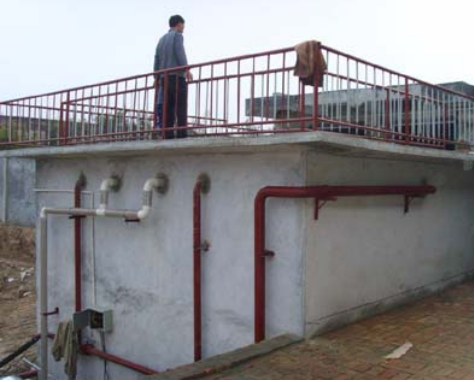
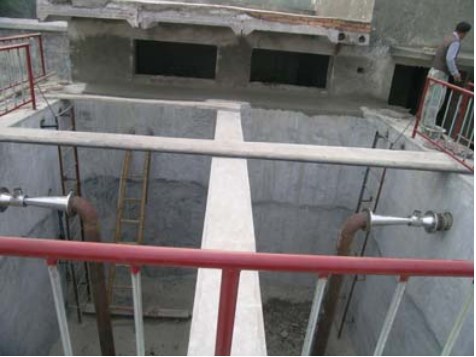
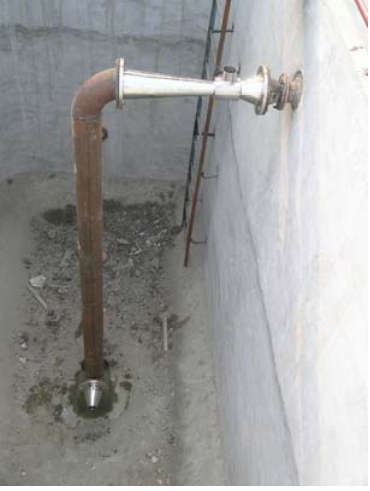
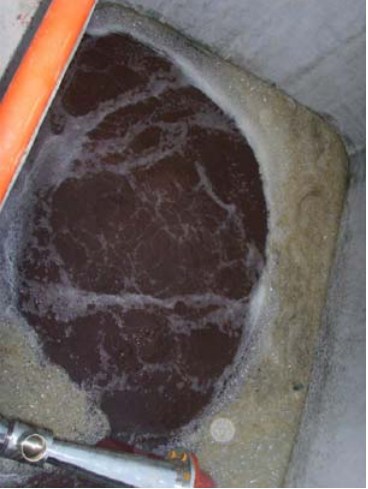
7. Related Photos