Chengdu GreenWater Co.,Ltd
Home
Library
Media
What Is a Venturi Injector? Working Principle, Advantages, and Selection Guide
What Is a Venturi Injector? Working Principle, Advantages, and Selection Guide
A. Venturi Injector:
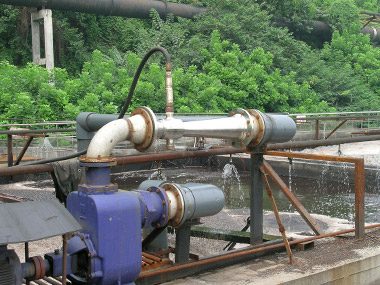
A Venturi injector is a device in which a fluid under a certain pressure passes through a nozzle, converting the static pressure energy of the fluid into kinetic energy, forming a certain negative pressure, and transferring kinetic energy to a secondary fluid so that the secondary fluid is drawn in.

B. Performance:
The performance advantages of a Venturi injector come from its “gas-liquid orthogonal jet” structure, which enables the fluid to form fine bubbles, strong turbulent diffusion, and full contact while reducing momentum loss, thereby improving gas-liquid two-phase mass transfer efficiency.
C. How a Venturi Injector Works:
The pressurized working fluid enters the injection chamber from the inlet of the Venturi injector and forms a high-speed jet. The high-speed fluid produces a pressure drop, causing the material to be added (liquid/gas) to be drawn in from the suction port and enter the working fluid. The mixed liquid then passes through the diffuser section to the outlet, where the flow velocity decreases and the pressure recovers (but remains lower than the inlet pressure).

D. Why Choose a Venturi Injector
1. Higher oxygen transfer efficiency, lower air supply demand, and low energy consumption;
2. Simple piping and installation, small footprint; resistant to clogging, aging, and corrosion, with low maintenance requirements;
3.
Long-term operating performance does not degrade;
4. Low operating noise;
5. Technical retrofit can be completed without draining water.
E. Venturi Injector Materials:
Venturi injectors can be made of brass, stainless steel, high-quality carbon steel, and other materials according to the application. In ozone or highly corrosive conditions, 304 stainless steel can be used in low-concentration ozone environments, 316L stainless steel can be used in high-concentration ozone environments, and more advanced materials such as Hastelloy or titanium alloy can be used for resistance to high-concentration chloride ion corrosion.
F. Venturi Injector Troubleshooting:
1. Pre-startup Inspection
After correct installation, start and stop the system according to the proper valve status. This is especially important for blower pressurization systems to prevent air from entering the pump body or water from entering the blower/air pipeline.
2. Whether Self-Suction Is Normal
Start the water pump according to the pump manual and confirm forward rotation. For submersible pumps, the wind speed at the self-suction air inlet can be measured; for external pumps, the motor rotation direction can be observed. If suction at the air inlet is obvious, the system is operating normally.
3. When It Cannot Work Normally
The injector itself does not generate a pressure difference; instead, it relies on the pressure loss of the power source through the injector and pipeline to form the pressure difference required for operation. If it cannot work normally, the installation position may be adjusted appropriately to meet the pressure difference requirement, and pressure gauges are recommended at the inlet and outlet.
G. Common Troubleshooting
1 Low inlet pressure and insufficient pressure difference: increase the pump head or add a booster pump.
2 The matching inlet and outlet connecting pipes are too small: use pipes consistent with the injector inlet and outlet.
3 Blockage in the connecting pipeline: remove the blockage.
4. The suction pipeline is dirty or blocked: blow it clean and remove the blockage.
5 Long-term operation causes internal fouling and dimensional changes: usually, it can be cleaned by soaking in 30% hydrochloric acid for about 30 minutes, then rinsing with clean water.
H. Venturi Injector Selection
Venturi injector selection cannot be based directly on a fixed model. It should be determined comprehensively according to actual oxygen demand, water depth, gas-water ratio, hydraulic retention time, inlet working pressure, outlet working pressure, water temperature, salinity, water quality, and other parameters.
Appendix:
Chengdu GreenWater Technology Co., Ltd. has professional R&D, design, and engineering application capabilities for Venturi injectors.
The company was founded in 2003 and is a leading enterprise in jet technology in China. In 2005, it completed industrial-scale tests using pure oxygen and air, accumulated empirical data, and established calculation and design models.
Through years of practice in air, ozone dosing, and pure oxygen applications, the company has formed a mature product series system. Its systems have achieved normal operation, acceptance compliance, and energy-saving results in projects such as the 600,000 m3/day municipal wastewater ozone dosing project and the ozone tail gas reuse project of Suez Water in Shanghai Chemical Industry Park.